
LLMJacking: detect stolen model access before the bill arrives
Detect LLMJacking through identity and usage signals, block suspicious traffic in real time, and understand where provider controls are still needed.
An attacker with a working model API key can spend your inference budget without touching your application. Requests can look ordinary: valid authentication, supported models, successful responses. Your application may stay healthy while someone else uses the account behind it.
LLMJacking is the unauthorized use of another organization’s model access or compute. Attackers can consume it themselves or resell access through a proxy. Sysdig documented this pattern in May 2024: attackers obtained cloud credentials from a vulnerable Laravel system, checked access to model services, and used tooling associated with a reverse proxy. Credential checks could reveal useful access without running a legitimate inference query. [1]
The defensive question is practical: can you connect a model request to an authorized workload, and can you stop spending when that connection breaks?
Detect activity on both sides of the gateway
Direct signals describe model use. Indirect signals describe the compromise that makes it possible. Correlating them gives responders more context than a billing spike alone.
| Signal | Evidence to collect | Detection and prevention approach |
|---|---|---|
| Model use outside an approved workload | Provider invocation records, credential fingerprint, workload identity, gateway request IDs | Reconcile provider activity with approved gateway traffic; investigate unexplained use after accounting for delivery lag and retries. |
| Sudden token or request growth | Per-identity requests, input/output tokens, concurrency and model | Compare with that workload’s history; enforce request, concurrency and token budgets on the controlled path. |
| Unexpected model or region | Model ID, region, principal and approved configuration | Alert on deviations; deny access to models and regions the workload does not need. |
| Secret exposure | Repository scanning, secret-manager audit events, runtime policy findings | Remove embedded keys, restrict secret access and rotate exposed credentials at the issuer. |
| New access or persistence | Key creation, role changes, service enablement and host changes | Correlate with later inference activity; restrict who can create identities, change permissions or enable services. |
| Reduced visibility | Logging configuration changes and ingestion health | Alert on disabled logging and missing telemetry; protect audit destinations from workload administrators. |
A new IP address alone is weak evidence. Deployment changes, VPNs, NAT gateways and regional failover all change network context. A high-volume batch job can be legitimate. Use approved change windows and workload ownership to explain changes. Keep a separate rule for unauthorized identity or policy changes even when request volume stays low.
What an attempt could look like in logs
The product-evidence screenshot below includes the example traffic graph. All counts and events in this scenario are synthetic.
The approved workload stays near 20 requests per minute. At 10:05 UTC, a credential appears from an unrecognized source at the gateway. Incoming traffic rises to 180 requests at 10:06 and 360 at 10:07. A correlated alert triggers real-time blocking at 10:07: 340 matching requests are rejected, while 20 approved requests continue upstream. At the 10:09 peak, Wingback blocks 600 of 620 attempts. The credential remains valid at its issuer; this control applies only to traffic passing through Wingback.
These are normalized example events, not a native provider schema:
{"time":"2026-10-20T10:05:03Z","source":"gateway","event":"model_request","credential_fingerprint":"key_demo_7f2a","source_ip":"203.0.113.42","approved_workload_match":false}
{"time":"2026-10-20T10:07:00Z","source":"correlation","event":"llmjacking_suspected","attempted_requests_1m":360,"allowed_requests_1m":20,"blocked_requests_1m":340,"identity":"svc-research-demo"}
{"time":"2026-10-20T10:07:00Z","source":"runtime_enforcement","event":"policy_enforced","action":"block","scope":"wingback_gateway","rule":"LLM-004"}
The address uses a documentation-only IP range. The credential value is an identifier, not a secret. A missing workload match is an enrichment result; it requires an inventory and correlation pipeline.
A starting detection rule could require more than 100 requests outside the approved workload in each of two consecutive minutes, plus credential use from an unapproved source. In this dataset, 10:06 and 10:07 meet those conditions. The illustration assumes enforcement begins at the start of the 10:07 bucket; production timing depends on event delivery and policy evaluation. Requests already admitted before enforcement cannot be undone.
These thresholds are illustrative. Tune them against batch workloads, traffic history, log delays and false positives. Add an independent low-volume identity rule so an attacker cannot stay invisible simply by staying below the threshold. A new IP or a count mismatch alone is a hunting lead, not proof of theft.
This example shows in-path protection. To hunt for direct provider use that bypasses Wingback, separately reconcile provider invocation records with gateway logs. Match request IDs where available, or compare deduplicated aggregates by account, identity, model, region and time window. Allow for retries and log delivery delays before investigating a discrepancy.
Prevent access, then bound the damage
Keep provider credentials on a controlled server or gateway. Prefer short-lived workload identity where supported, and give each workload the minimum model permissions it needs. Separate development and production credentials. Require authentication on self-hosted inference endpoints, patch the hosting stack, and restrict administrative endpoints.
Enforce budgets where requests are admitted. Combine a token allowance, concurrency limit and model allowlist with a response that can refuse the next request. Reserve capacity for in-flight requests and retries so concurrent workers cannot all spend the same remaining allowance. Billing alerts help responders, but they are not a guaranteed spending stop.
An inline control only governs traffic that passes through it. If an attacker has the upstream provider credential, blocking a gateway session will not stop direct calls from an external machine. Where supported, use provider IAM and network restrictions to limit those calls. During an incident, revoke the compromised provider credential, examine newly created identities and permissions, and fix the original exposure before issuing replacement access.
Collect enough metadata to investigate without building a second store of sensitive prompts. Preserve timestamps, stable identity references, model, region, status, token usage and request IDs where available. Verify coverage for each endpoint. AWS documents that Bedrock model invocation logging is disabled by default and can collect request and response contents when enabled. Review retention and access controls before turning on payload logging. [2]
Where Wingback fits
Wingback’s documented runtime defense approach places controls in the inference and tool path. Its published capabilities describe model and tool allowlists, rate and budget thresholds, and responses including throttling, blocking and session termination. These controls can limit misuse in traffic routed through an enforced integration. [3]
That gives teams a direct control point for unauthorized model selection, excessive agent activity and policy violations. Secret inspection can also reduce one indirect route to credential exposure when sensitive values appear in inspected agent traffic. It cannot recover a key already stolen from an unrelated repository or compromised cloud host. [4]
The proposed alert below shows runtime evidence and real-time blocking for traffic passing through Wingback. Wingback does not currently revoke provider access. Credential rotation or revocation remains an action for the credential owner at the provider. The dedicated LLMJacking correlation rule and illustrated interface are product concepts, not a claim that this exact alert is shipped.
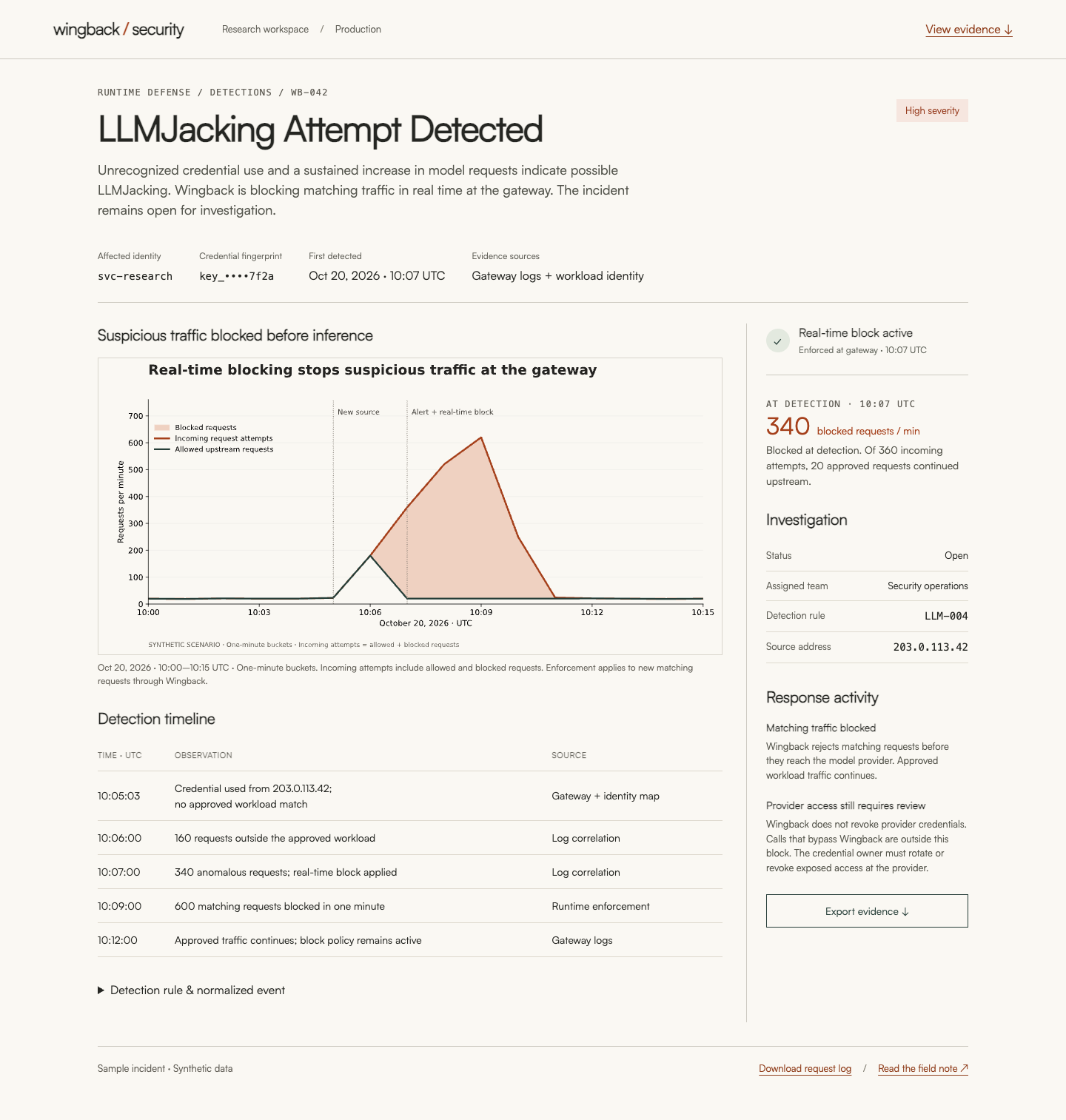
Product concept with synthetic evidence. Wingback blocks matching traffic in real time; provider credential remediation remains with the credential owner.
Start by testing one question in your environment: if a development credential were used directly against the provider, would your team see it, identify its owner, and revoke it without waiting for the invoice?
November 11 update: what Google’s new research adds
Google Threat Intelligence Group and Mandiant’s November 2 report describes stolen cloud identities, exposed model endpoints and downstream resale gateways called LLM Mixers. It also describes attackers validating stolen keys with minimal single-token requests, which can evade simple volume-based alerts. [5]
For defenders, this reinforces the value of early identity signals alongside usage monitoring. Review unexpected credential creation, service enablement and privilege changes before the spending spike. Protect the gateway’s administrative surface as well as the models behind it. This update covers research published after the October 21 article date.
Sources
- Sysdig: LLMjacking: Stolen Cloud Credentials Used in New AI Attack, May 6, 2024
- AWS: Monitor model invocation using CloudWatch Logs and Amazon S3 (documentation checked November 11, 2026).
- Wingback: Automatic agent containment
- Wingback: NVIDIA OpenShell and Wingback
- Google Cloud: The Rise of LLMJacking, November 2, 2026
Keep reading
- BlogNVIDIA OpenShell and Wingback: securing agents at runtimeOpenShell governs what an AI agent can access. Wingback, connected through the OpenShell supervisor, checks what it sends to…
- BlogOne rogue agent in a shared-credential fleet: contain it, kill it, keep the rest runningWhen a fleet of AI agents shares credentials, you can contain the one that goes rogue, kill it if you need to, and keep every…
- BlogAutomatic agent containment: stop drift before you need the kill switchOWASP AISVS requires policy violations to trigger automated containment. How graduated responses (throttle, block, terminate)…
Platform
AI Runtime DefenseWingback sits inline at the inference path, correlating multi-signal detection into one response, sealing data on the wire, and replaying every session.