
Automatic agent containment: stop drift before you need the kill switch
Wingback Security · 7 min read
An emergency stop matters when an agent is already on fire. Most production pain starts earlier: a refund bot touches a path it never declared, a coding assistant spikes tool calls past any sane budget, or a session keeps retrying a blocked action until cost and risk climb together.
The fix for that gap is automatic containment: runtime policy that degrades or stops unsafe agent behaviour the moment a rule is broken, without waiting for a human to find the red button.
This Field note is about that middle layer. Inventory tells you what exists. An Agentic Kill Switch is the last resort. Automatic containment is what should fire in between.
What OWASP AISVS actually asks for
The OWASP AI Security Verification Standard (AISVS) chapter on orchestration and agentic security is specific enough to buy against. Requirement 9.3.8 is blunt: policy violations must trigger automated tool containment: stopping execution, isolating the tool, or revoking its permissions. It sits at Level 3 because detection alone does not satisfy it.
Nearby controls make the same posture concrete:
- C9.1 bounds recursion, budgets, and runaway loops with circuit breakers.
- C9.5 insists every privileged action is authorized at execution time by a policy engine, not by the model’s self-assessment.
- C9.6 still wants a manual kill switch, but as a human-controlled shutdown path, not as your only response to ordinary policy breaches.
Taken together, AISVS lines up with what security teams already do in endpoint and identity programs: graduated response beats binary panic. You throttle noisy sessions. You block a bad tool call. You terminate a loop that will not stop. You keep a human override for the rare case that needs a fleet-wide stop.
If your “containment” story is a Slack page and a hope that someone is awake, you are failing 9.3.8 in practice even if your architecture diagram looks modern.
Why a kill switch alone is the wrong default
A kill switch answers one question well: can an authorized human sever the next action right now? Buyers should still demand that control. It is not the right default for every drift signal.
Teams that treat emergency stop as everyday policy keep hitting the same failure modes:
- Operators are slower than tool loops. An agent can burn through dozens of tool calls while someone is still opening the dashboard.
- Binary stop is politically expensive. Teams hesitate to wire a hard stop to soft anomalies, so they leave the switch unused until damage is already done.
- You lose the useful middle. Throttle, sanitise, and single-action block often fix the incident without killing a whole workflow that other users still need.
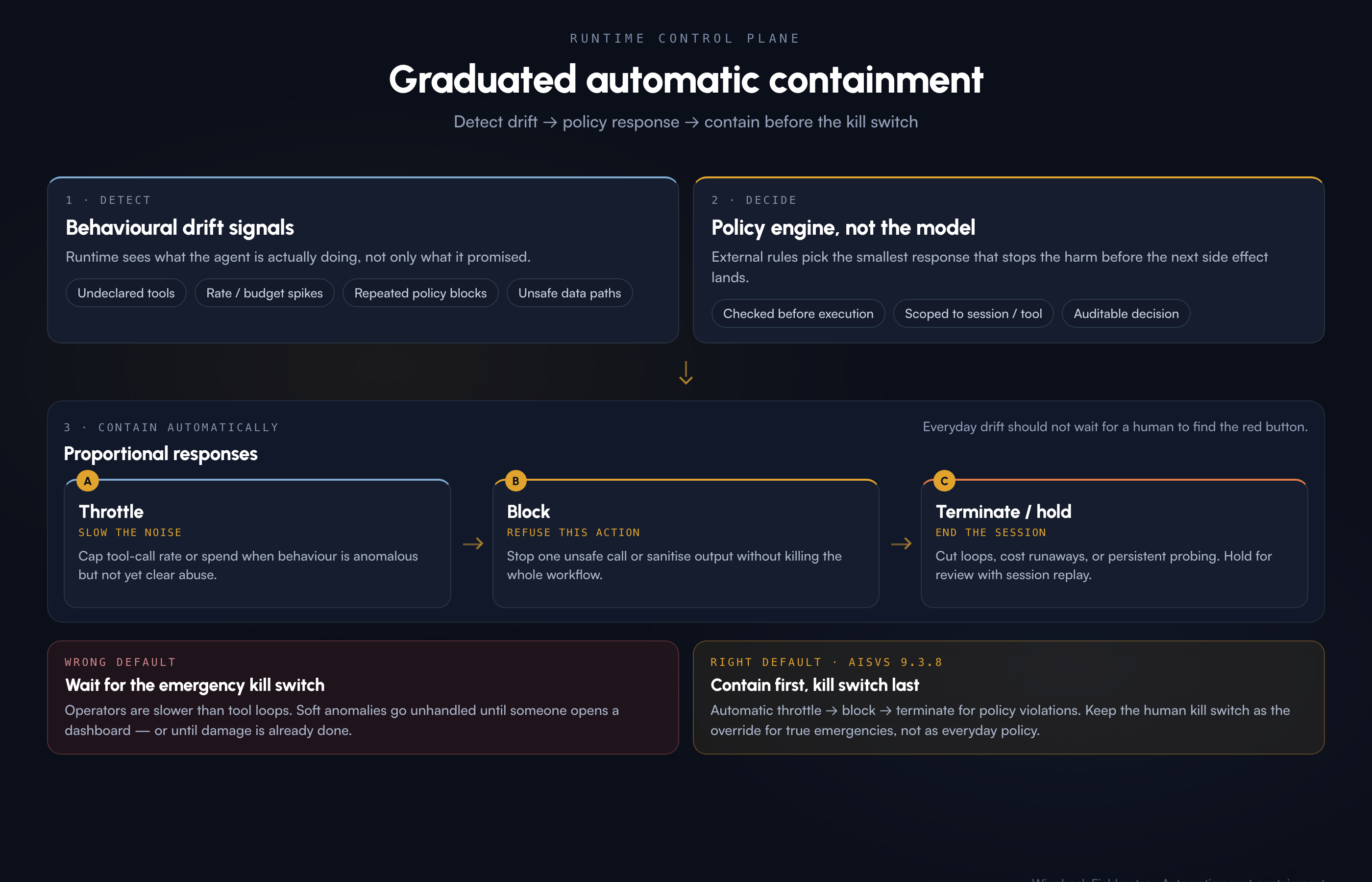
Automatic containment fills that gap. Policy says what “bad” looks like. The runtime applies a proportional response when that condition is met. Humans still get the kill switch for true emergencies. They should not be the first line for every rate spike or scope drift. The diagram at the top of this note is the control story buyers should expect: detect drift, let policy pick a proportional response, and keep the emergency kill switch as the last resort rather than the everyday path.
Signals that should contain, not only alert
The signals worth wiring to automatic response already show up in how serious teams describe runtime defense.
Behavioural drift. The agent’s declared tools and intent no longer match what it is actually calling. A support bot that suddenly reaches object stores it never listed is not a content problem first. It is a containment candidate.
Rate and budget abuse. Tool-call frequency or spend climbs past a per-agent threshold. AISVS C9.1 expects quotas and budgets to be enforceable. An alert after the invoice lands is accounting, not security.
Repeated policy blocks. The same session keeps attempting a denied tool path. At some point “detect and allow” becomes a rehearsal for bypass. Containment means the session cannot keep probing.
Unsafe tool or data paths. Secrets in tool output, off-policy destinations, or arguments that violate allowlists. Inline block or sanitise handles the single call; repeated hits should escalate severity automatically.
The Cloud Security Alliance’s research note on sandboxing agentic AI and least-privilege patterns for MCP and coding agents pushes the architectural side of the same idea: capability scoping, deny-by-default egress, and tamper-resistant audit. Containment without least privilege is just a late brake. Least privilege without automatic response is a fence with no gate guard.
What good automatic containment looks like
When you evaluate ADR, ask how the control behaves under load, not how the slide deck describes it.
Policy-driven, not prompt-driven. The model must not be the enforcer. AISVS 9.5.3 is explicit: access decisions belong to application logic or a policy engine. A system prompt that says “be careful” is not containment.
Checked before side effects. Containment that logs after the refund, the email, or the shell write is forensics. Useful. Not the control.
Graduated severity. Monitor → throttle → block this action → terminate this session → human kill switch / broader stop. Start with the smallest response that stops the harm.
Scoped. Prefer containing one agent, one session, or one tool class before freezing an entire fleet. Broad stops still matter; they should not be your only dial.
Auditable. Who or what triggered containment, which policy version, which action was refused, and what evidence remains for the SOC. If you cannot replay the session, you will re-litigate the decision in the postmortem.
Dry-run capable. Teams need to see what would have contained before they flip enforcement on production traffic. Automatic rules that only exist as code reviews never get trusted.
Inventory and red teaming still matter. Automatic containment is the runtime layer that makes those investments enforceable while agents are live.
How Wingback maps to automated containment
Wingback’s public Agent Detection & Response story is built around inline response, not alert-only monitoring. Per platform capabilities and AI Runtime Defense, Wingback sits in the inference and tool path as a gateway proxy, Kubernetes sidecar, or SDK guard, and can block, sanitise, throttle, terminate, or alert on agent actions, tool calls, and data flows.
That response set is the practical mapping to AISVS-style automated containment:
- Throttle for noisy or anomalous rates that do not yet justify a hard stop.
- Block or sanitise for the single unsafe call (secrets in tool output, off-policy data movement, disallowed tools).
- Terminate when loops, cost caps, or behavioural drift cross a threshold, with cost caps enforced so a runaway session cannot keep spending after the decision.
- Alert and capture when you need investigation mode with a full session replay, not a silent drop.
Behavioural guardrails on the runtime page describe the signal side: drift between declared intent and observed tools, cross-agent cascade scoring, and rate-plus-budget thresholds with auto-terminate. Agent guardrails add per-agent tool and model allowlists, budget caps, recursion limits, handoff and intent tracing, and a kill switch when a human still needs an emergency stop.
Automatic containment is the everyday policy path. The kill switch remains the operator override. Both belong in the same control plane. Neither lives inside the model’s prompt.
Wingback does not replace careful least-privilege design or sandboxing. It makes policy violations enforceable at the moment of attempt, with evidence you can hand to security and audit teams.
What to demand this quarter
- Separate automatic containment from manual kill switch in your ADR RFP. Ask how each is triggered and who can override.
- Require at least three graduated responses short of fleet halt (for example throttle, block, terminate session).
- Wire behavioural drift and rate/budget thresholds to enforcement, not only to dashboards.
- Insist on session replay for every containment decision so SOC can explain what happened without reconstructing logs by hand.
- Map your control narrative to OWASP AISVS C9.1, C9.3.8, C9.5, and C9.6 so product, security, and compliance share one checklist.
Credits and further reading
- OWASP: AI Security Verification Standard, C9 Orchestration & Agentic Security
- Cloud Security Alliance: Sandboxing Agentic AI: Least Privilege Patterns for MCP and Coding Agents
- Wingback: Platform capabilities and AI Runtime Defense
Wingback product claims above refer to publicly documented capabilities. No customer names, fabricated statistics, or internal implementation details appear in this post.
Talk with Wingback
If your agents can already call tools that write, spend, or leave the perimeter, waiting for a human to hit an emergency stop is too late for most drift. You need automatic containment that throttles, blocks, or terminates when policy is violated, and a kill switch when the situation still escalates.
Request a demo and we will walk through how Wingback would put graduated inline responses on your agent and MCP paths for the automatic containment gap this post describes.