
Map every AI surface,
even the agents
nobody registered.
AI Surface Intelligence finds every agent, model and MCP server across your cloud, code and laptops, scores each one for risk on a calibrated 0‑100 scale, and routes the finding to the team that owns the fix.
Sample data: a profile card that cycles through three AI assets. An unregistered agent, found on a laptop by the endpoint sensor, reaches filesystem:write and a shell; its owner is resolved to @growth-eng and its risk is 82 of 100. checkout-agent (prod), a Bedrock agent found in AWS by a cloud scan, reaches claude-opus-4-7 and 4 tools, is owned by @payments, and its risk is 28. files-mcp, an MCP server found in a repository by a code scan, reaches filesystem:read and 3 tools, is owned by @platform, and its risk is 52.
01Coverage
Built to see your entire AI stack.
Wingback ships with native discovery for every major AI platform, framework, and tool, so you don’t write connectors for the things you already pay for.
- Foundation models
- OpenAI, Anthropic, Google, Meta, Mistral and 10 more
- AI applications
- ChatGPT, Claude.ai, Microsoft Copilot, Gemini and 6 more
- Agent frameworks
- LangChain, LangGraph, LlamaIndex, CrewAI and 8 more
- Cloud & infra
- AWS, GCP, Azure, Kubernetes and 6 more
- Coding agents
- Cursor, Claude Code, GitHub Copilot, Windsurf and 4 more
- MCP ecosystem
- Anthropic, GitHub, Linear, Slack, Notion, filesystem and database MCPs
- Open-source agents
- AutoGPT, BabyAGI, MetaGPT, AgentGPT, Smol Agents, OpenDevin
02How it works
Connect it once.
The map keeps itself current.
Discovery is a standing process, not a scan you schedule. Five steps, and only the first one asks anything of you.
After you connect, steps 02 to 04 run on their own and repeat as the collectors find new assets.


-
01you, once
Connect
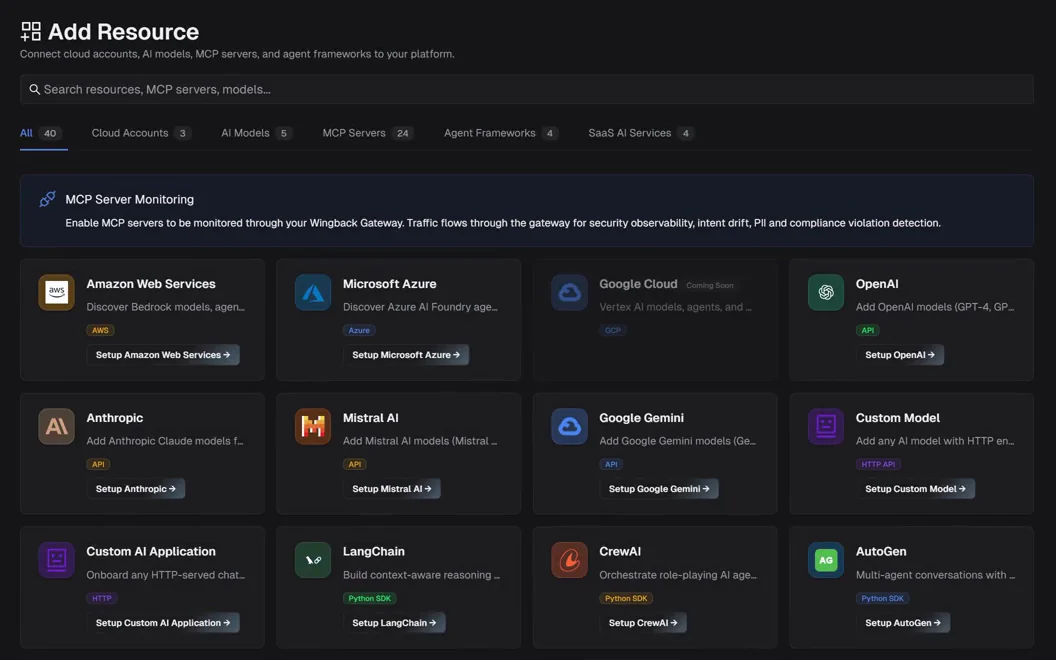
Point Wingback at your cloud accounts, source repositories and engineering endpoints. The collectors run continuously from then on.
-
02
Discover
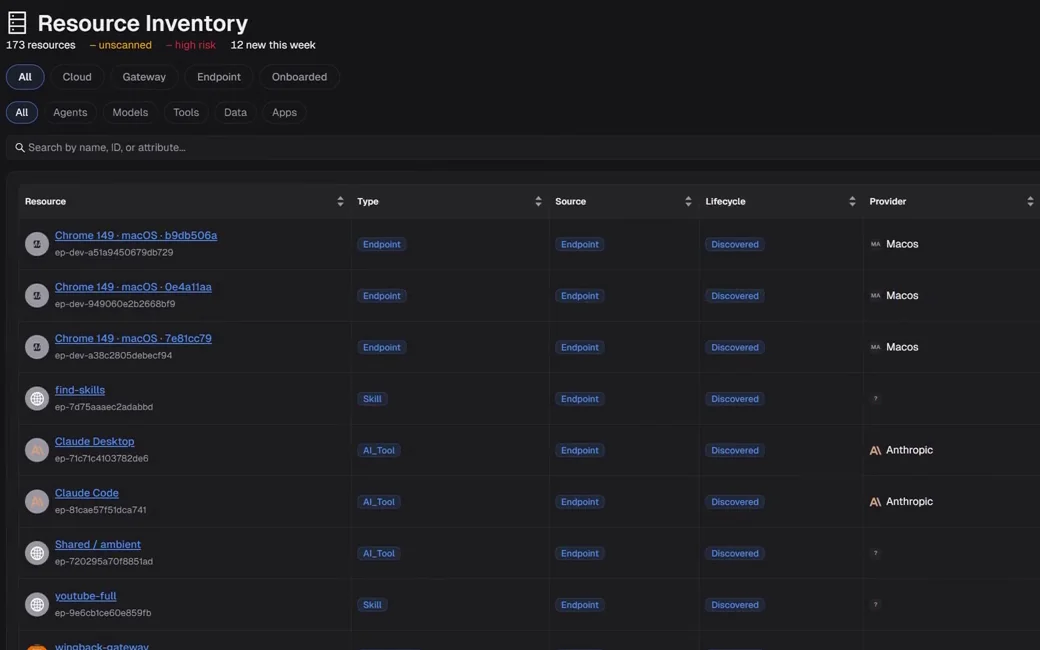
New assets land in the inventory as the collectors find them, already scored, owned and watched.
-
03
Profile
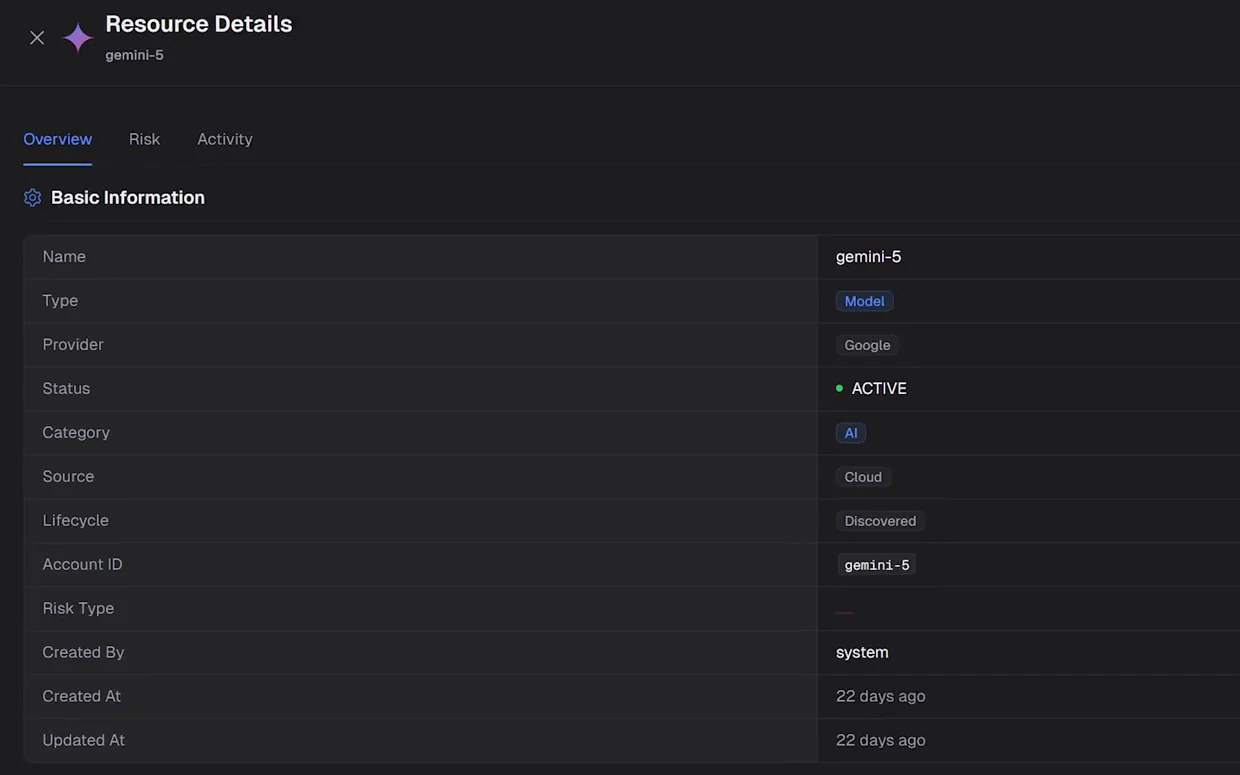
Each asset is profiled for configuration, exposure, change history and ownership, then mapped to the standards that govern it.
-
04
Route
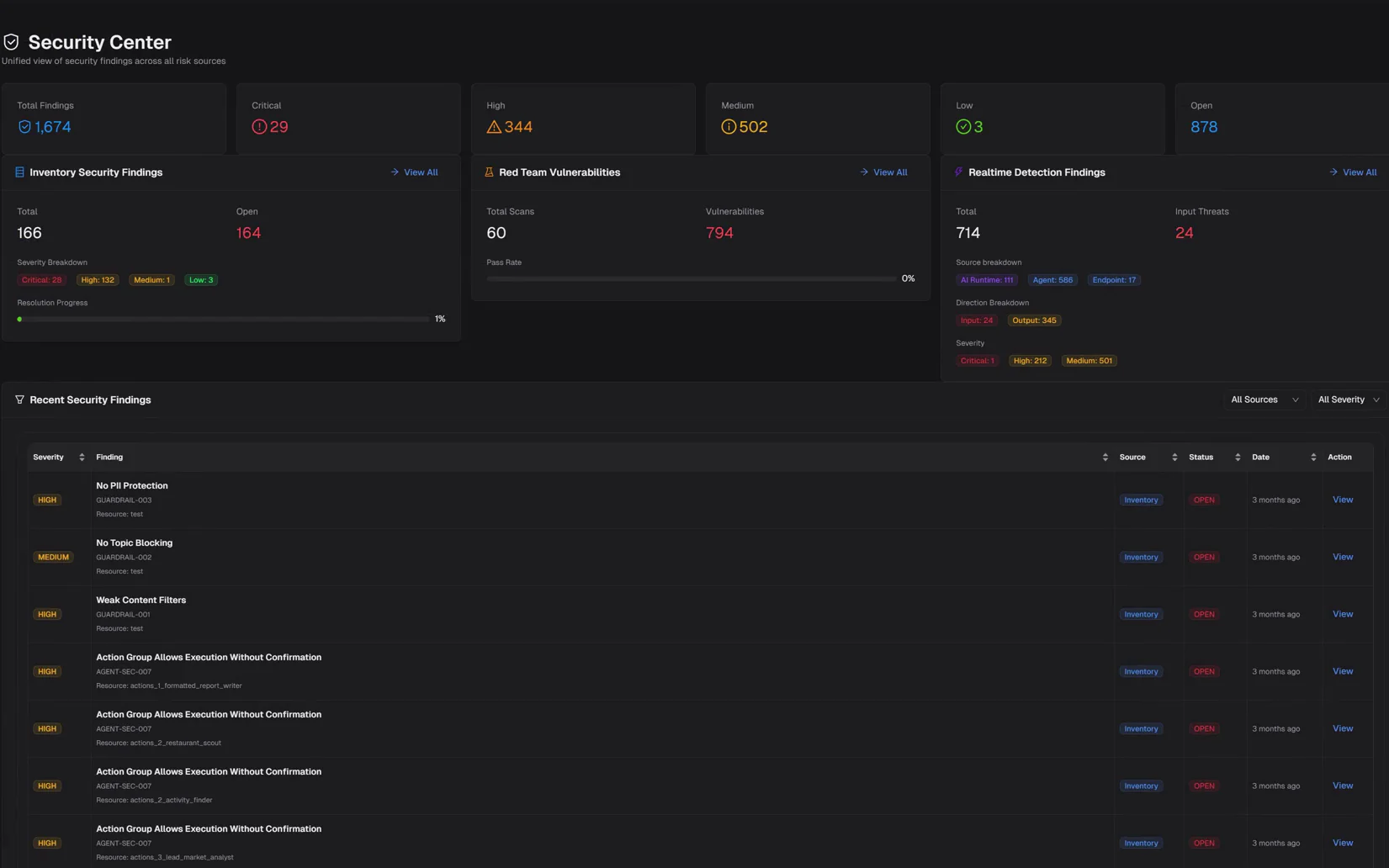
Findings go to the team that owns the fix with a response SLA attached, rather than into a single security queue nobody reads.
-
05forward-deployed engineer
Tune
Your forward-deployed engineer tunes the collectors to your stack: proprietary frameworks, in-house MCP servers, the cloud account no one remembers.


03FAQ
AI Surface Intelligence, answered.
What is AI Surface Intelligence?
AI Surface Intelligence is Wingback's continuous discovery layer. It maps every agent, model, MCP server, tool, prompt, and data source running across your cloud accounts, source repositories, and engineering workstations, profiles each one for configuration, exposure, change history, and ownership, scores it on a calibrated 0-100 scale, and routes the finding to the team that owns the fix.
What counts as an AI asset?
Anything that runs a model or reaches one: an agent, a hosted or self-hosted model, an MCP server, a tool or function an agent can call, a system prompt, a vector store, and the inference path between them. A ChatGPT tab on an engineer's laptop and a Bedrock agent in a production account are both assets, and both arrive with an owner and a score.
Do we have to route traffic through a gateway to be discovered?
No. Cloud and code discovery is agentless: Wingback reads your AWS, GCP, and Azure accounts and your GitHub, GitLab, and Bitbucket repositories through their own APIs. Workstation coverage uses an endpoint sensor on macOS, Windows, and Linux. Nothing has to be rebuilt, re-registered, or pointed at a proxy before it can be found.
How is this different from CSPM or a CASB?
A CSPM can tell you a Bedrock endpoint exists. It cannot tell you which agent calls it, which tools that agent can reach, which system prompt it runs, or who owns it. Wingback resolves the AI layer specifically: the agent, its tool scope, its data lineage, and the human accountable for it.
What does the endpoint sensor see on an employee laptop?
AI tool activity, not general browsing: ChatGPT and Claude sessions, Cursor, Claude Code, and Copilot use, local MCP servers over STDIO, personal API keys, local Ollama and LM Studio instances, browser extensions calling models, and data leaving to providers you have not sanctioned.
How is the posture score calculated?
Every asset carries a calibrated 0-100 score built from four weighted factors: configuration at 30 percent, change history at 25 percent, exposure at 25 percent, and ownership clarity at 20 percent. Engineers sort by score and fix the worst first, and the score moves when the configuration moves rather than on a review cycle.
Which standards are discovery findings mapped to?
Findings are tagged at discovery time against ISO 42001, the NIST AI RMF, the OWASP LLM Top 10, the EU AI Act, and MITRE ATLAS, so a discovery finding arrives as a compliance artefact rather than becoming one later.
What happens to an asset after it is discovered?
It is profiled, scored, and routed. The finding goes to the team that owns the fix with a response SLA attached, rather than into a single security queue, and the asset stays under continuous assessment so drift, a widened permission, or a silent model swap raises a new finding.
Which clouds and code platforms does discovery cover?
Wingback reads your AWS, GCP, and Azure accounts and your GitHub, GitLab, and Bitbucket repositories through their own APIs. Cloud and SaaS coverage includes AWS Bedrock and AgentCore, Azure OpenAI and AI Foundry, Microsoft Copilot Studio, Salesforce Agentforce, SageMaker endpoints, self-hosted LLMs such as vLLM and Ollama, and RAG indexes and vector stores. In code it finds OpenAI and Anthropic SDK calls, LangChain, AutoGen, and LlamaIndex agents, hard-coded system prompts, and MCP server registrations.
Does Wingback find MCP servers?
Yes. In code, discovery reads MCP server registrations in your repositories; on laptops, the endpoint sensor sees local MCP servers running over STDIO. Coverage spans the MCP ecosystem, including GitHub, Linear, Slack, Notion, filesystem, and database MCPs. Each server is profiled for its permission scope, owner, approval state, runtime usage, and change diff, so a server that gains filesystem:write raises a new finding.
How does Wingback find shadow AI?
It looks where AI actually runs, not where it was registered. On laptops, the endpoint sensor catches a personal ChatGPT account pasting strategy documents or a Cursor session reading customer records. In the cloud and in code, scans and drift comparison surface a Bedrock agent in a dev account holding production credentials, a self-hosted model with no authentication, or an MCP server that gained filesystem:write. Every first scan surfaces AI assets the CISO can't account for, and each one arrives with an owner and a score.
What does connecting Wingback require?
One step, done once: you point Wingback at your cloud accounts, source repositories, and engineering endpoints. Cloud and code are read agentlessly through the providers' own APIs, and laptops run an endpoint sensor on macOS, Windows, and Linux, so nothing has to be rebuilt, re-registered, or pointed at a proxy. Connect your cloud and code, and you'll have a scored inventory in under an hour.
How often does the inventory update?
Continuously. Discovery is a standing process, not a scan you schedule: once connected, the collectors keep running, and new assets land in the inventory as they are found and pick up a risk score in seconds. Every asset stays under continuous assessment, so drift, a widened permission, or a silent model swap raises a new finding, and the score moves when the configuration moves rather than on a review cycle.
Can discovery show which agents touch sensitive data?
Yes. Discovery is a graph, not a list: Wingback maps every dependency between agents, models, tools, and data sources, so you can answer the questions you actually get asked, such as which agents touch PHI, which workflows depend on a deprecated model, and which integration would break if a vendor goes down. Each data source carries its sensitivity class and the agents that read it.
Does Wingback produce an AI bill of materials?
Yes. Discovery produces a CycloneDX 1.6 AI bill of materials (AIBOM) for each model and agent, versioned and exportable.
Something else? Talk to our team.
04Keep reading
- GlossaryShadow AIAI tools and agents used inside an organization without security's knowledge or approval: personal ChatGPT accounts…
- GlossaryMCP securitySecuring the Model Context Protocol: the servers, tools, and transports that agents use to reach external systems.
- GlossaryAI Bill of Materials (AIBOM)A structured inventory of the AI components in a system: models, agents, datasets, and their provenance, versions, and risks.
- BlogCISOs: You Don't Control the Frontier. You Do Control What It Deploys.Three takes on pacing the frontier, from Amodei, Beri, and Arora, and why a security program shouldn't be built around any of…
- BlogOur Baseten connector: cover the models you host, not just the ones you rentWingback now discovers, guards, and red-teams the models you serve on Baseten (dedicated deployments, Model APIs, and Chains)…
Next capability
AI Runtime DefenseWingback sits inline at the inference path, correlating multi-signal detection into one response, sealing data on the wire, and replaying every session.
Updated