
Why AI Security Requires a Multi-Layer Platform
Wingback Security · 8 min read
AI security is often discussed as a collection of separate problems.
One product tests models before deployment. Another protects AI applications at runtime. A third discovers unsanctioned AI usage across employee devices. Each product may solve a valid problem, but treating these areas as independent security verticals misses the larger picture.
We believe AI security is fundamentally a multi-layer, multi-stack problem.
Red teaming, runtime security, and endpoint shadow AI are not isolated controls. They represent different stages of the same risk lifecycle. The weaknesses discovered before deployment influence the policies needed during runtime. Runtime activity reveals risks that should be tested more thoroughly. Endpoint visibility shows where employees are using AI outside approved applications and controls.
When these layers operate independently, security teams receive fragmented findings without enough context to understand the organization’s actual exposure.
That is why AI security must be approached as a platform problem.
AI Risk Does Not Stay Within One Layer
Traditional application boundaries are becoming less clear.
AI systems connect models, data sources, agents, APIs, SaaS applications, MCP servers, browser sessions, and employee endpoints. A single AI interaction can cross several of these layers in seconds.
Consider an employee using an unsanctioned AI tool to summarize a document containing confidential information. This begins as a shadow AI problem at the endpoint. It immediately becomes a data security problem when sensitive information leaves an approved environment. It may also become a compliance problem if the interaction is not logged, governed, or retained according to company policy.
Now consider an approved AI agent with access to internal systems. The agent may have passed an initial security assessment, but its behavior can change based on prompts, retrieved data, connected tools, model updates, and application logic. A weakness discovered through red teaming may only become exploitable under specific runtime conditions.
These are not separate incidents. They are different views of the same security problem.
Red Teaming: Understanding What Can Go Wrong
AI red teaming helps organizations identify weaknesses before attackers, or users, find them.
This can include testing for prompt injection, data leakage, unsafe model behavior, excessive agency, insecure tool access, policy bypasses, and other forms of adversarial manipulation. It allows security teams to evaluate how an AI system behaves outside its intended happy path.
But red teaming is not a one-time certification exercise.
AI applications are dynamic. Models change. Prompts evolve. New tools are connected. Retrieval sources are updated. Agents receive additional permissions. A system that was tested three months ago may not have the same risk profile today.
Red teaming therefore needs context from production. Which attacks are appearing at runtime? Which policies are being triggered? Which models and tools are actually being used? Where are users finding ways around approved workflows?
Without this feedback loop, testing risks becoming broad but disconnected from real exposure.
Runtime Security: Protecting AI in Motion
Runtime AI security operates where prompts, responses, data, models, and tools interact.
It can inspect AI traffic, detect sensitive data, enforce guardrails, identify malicious inputs, monitor model behavior, and apply policy before an interaction reaches the model or returns to the user.
This layer is essential because pre-deployment testing cannot anticipate every production condition. Real users will provide unexpected inputs. Attackers will adapt their techniques. Models may behave differently when combined with live data and tools.
However, runtime controls also need information from other layers.
A gateway can enforce policies for traffic that passes through it, but it cannot protect AI usage it cannot see. If employees access external AI applications directly from their browsers or devices, those interactions may bypass the organization’s approved runtime controls entirely.
Runtime security is therefore necessary, but it is not sufficient on its own.
Endpoint Shadow AI: Discovering Usage Outside Your Controls
Shadow AI is one of the clearest examples of why AI security cannot be solved within a single vertical.
Employees adopt AI tools because they are useful and easy to access. They may use public chatbots, browser extensions, desktop applications, coding assistants, or AI features embedded inside existing SaaS products. This adoption can happen long before security teams have evaluated the tools.
Blocking every AI application is rarely a sustainable answer. At the same time, allowing unrestricted usage creates obvious risks around sensitive data, intellectual property, regulatory obligations, and third-party exposure.
Organizations first need visibility.
Which AI applications are being used? Who is using them? What categories of information may be shared? Is the application sanctioned? Does an approved alternative exist? Are existing policies being bypassed?
Endpoint shadow AI visibility helps answer these questions. More importantly, it helps security teams connect unsanctioned usage with the broader AI security strategy.
If employees repeatedly use a particular external tool, that may indicate a gap in approved AI capabilities. If sensitive information is being entered into public models, runtime data policies may need to be extended or reinforced. If a new AI application becomes widely adopted, it may need formal red-team assessment before being sanctioned.
Discovery should drive action across the platform.
Why Point Solutions Create Fragmented Risk
Point solutions are not inherently ineffective. The problem is what happens between them.
A red-team platform may produce technical findings without knowing whether the affected system is used in production. A runtime security tool may generate policy violations without connecting them to previously identified vulnerabilities. An endpoint product may discover shadow AI without understanding whether the same user, data, or application is already associated with other AI risks.
Security teams are then left to correlate everything manually.
This fragmentation creates several problems:
- Duplicate findings across different tools
- Inconsistent risk scoring and policy enforcement
- Limited context for incident investigation
- Separate dashboards for related security events
- Difficulty proving control effectiveness
- Gaps between discovery, remediation, and ongoing monitoring
AI security needs a shared understanding of applications, models, agents, users, data, policies, and findings. That shared context is difficult to create when every layer operates as its own isolated product.
AI Security Is a Platform Problem
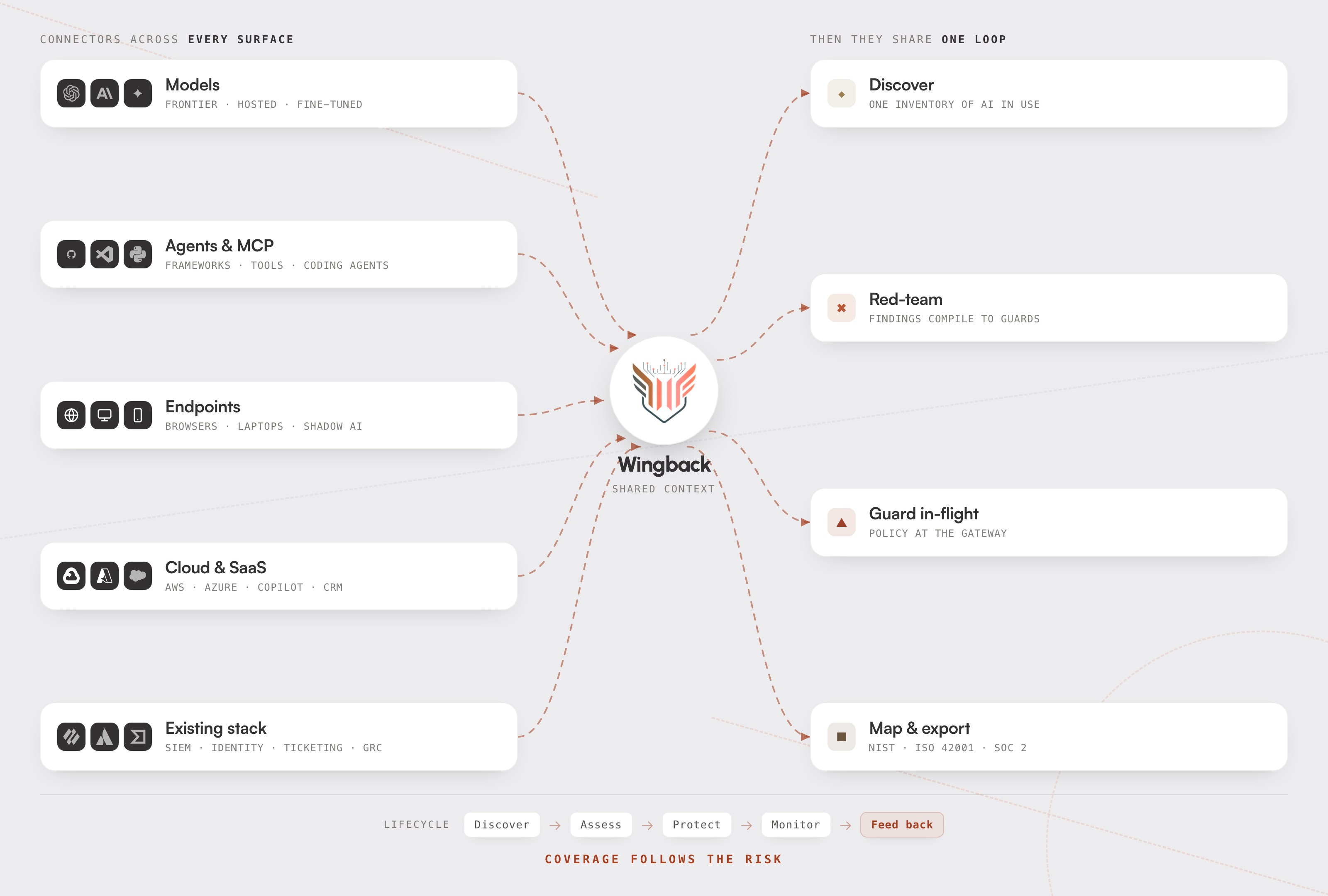
A platform-based approach does not mean placing unrelated features on one dashboard. It means connecting the layers so that information from one control improves the effectiveness of the others.
Red-team findings should inform runtime policies. Runtime events should influence future testing. Endpoint discoveries should identify new applications requiring assessment or governance. Sensitive-data detections should be correlated across approved and unsanctioned AI usage.
This creates a continuous security lifecycle:
- Discover where AI is being used.
- Assess the risks associated with those systems.
- Protect approved AI interactions at runtime.
- Monitor behavior and policy violations.
- Feed production intelligence back into testing and governance.
The value is not simply consolidation. It is context.
A security team should be able to move from a risky endpoint interaction to the user, application, data category, relevant policy, related runtime events, and applicable compliance control without manually assembling the story across multiple systems.
The Platform Must Integrate With the Existing Security Stack
AI security cannot become another isolated control plane.
Enterprises already rely on observability platforms, SIEM systems, data security tools, identity providers, ticketing systems, and governance, risk, and compliance workflows. AI security needs to contribute context to these systems while also consuming the signals they produce.
For example, an AI policy violation may need to appear in an existing security operations workflow. Runtime telemetry may need to be correlated with application and infrastructure logs. Remediation tasks may need to flow into the organization’s ticketing process. Evidence may need to be mapped to frameworks such as the NIST AI Risk Management Framework, ISO/IEC 42001, SOC 2, and applicable privacy requirements.
An AI security platform should not ask organizations to abandon their current security and compliance investments. It should extend them into a new technology layer.
This is especially important for CISOs. The goal is not to create a separate AI security organization with separate processes. The goal is to give existing security, engineering, privacy, and compliance teams the visibility and controls required to govern AI consistently.
AI Security Is an Extension of Data Security
At its core, much of AI security is data security.
AI systems consume large volumes of enterprise data. They transform it, summarize it, generate new content from it, and sometimes send it to third-party models or services. Agents can go further by retrieving records, calling tools, and taking actions across connected systems.
The fundamental questions remain familiar:
- What data is being accessed?
- Who or what is accessing it?
- Where is it being sent?
- What policies apply to it?
- Is the access necessary and authorized?
- Can the organization detect and investigate misuse?
What changes with AI is the speed, scale, and ambiguity of the interaction.
A user may expose sensitive information through a natural-language prompt without realizing it. A model may reproduce confidential context in its response. An agent may combine individually harmless data into a sensitive result. An employee may move from an approved application to an unsanctioned one with a new browser tab.
Existing data security principles still apply, but they must now operate across models, prompts, responses, agents, tools, and endpoints.
AI security is therefore not a replacement for data security. It is the next extension of it.
Building AI Security as a Connected System
Organizations do not need more disconnected alerts. They need a connected view of how AI is built, used, attacked, and governed.
That requires bringing together three critical capabilities:
- Red teaming to identify how AI systems can fail
- Runtime security to protect AI applications in production
- Endpoint shadow AI visibility to discover usage outside approved controls
These capabilities become significantly more valuable when they share context and integrate with existing observability, security, and compliance systems.
That is the approach we are taking at Wingback.
We believe AI security must follow risk wherever it moves: across development, production, data, models, agents, applications, and employee endpoints. Because attackers do not think in product categories, and enterprise risk does not remain inside a single layer.
If you want to see how Wingback brings these layers together, request a personalized demo.